
This companion goes with the Sanctuary Prayer Walk. It gathers the prayers of Scripture, station by station, and a set of simple ledgers for the week. You are not meant to read it through. Open it at the station you are standing in.
Part One, The Prayers of Scripture, Station by Station
Part Two, The Seven Ledgers
A reference volume. You are not meant to read it through. You are meant to open it at the station you are standing in.
PART ZERO, THE TEST

Before the lists, the rule that decides what belongs where. It exists because a hymn or a psalm can carry a sanctuary word while doing a different station’s work.
The three questions, in order of weight:
- What work does it do? Is it confessing, washing, receiving, asking, or beholding? The work governs.
- What direction does it move? Approach · transfer · washing · filling · receiving · ascending · stillness. A hymn that moves the wrong way is in the wrong room, whatever it names.
- What furniture does it name? Weakest test, but never ignore it, a room full of people will hear the word and locate themselves by it.
The trap: a text that names one station’s furniture while doing another station’s work. When that happens, use it as a bridge, sing it at the end of one station to carry the room into the next. That is not a compromise. It is what the word was going to do anyway.
Corrections to what we had
527, From Every Stormy Wind. I placed this at the incense and called it the definitive incense hymn. That was over-eager. The mercy seat is the lid of the ark, Most Holy furniture, not incense furniture. What the hymn does is prayer and access, which is incense work; what it names sits behind the veil.
The fix, and it is better than either placement: sing it as the bridge. Last hymn at the incense, carrying the room through the veil into the Most Holy Place. The hymn is literally about a place of retreat found beneath the mercy seat, and Hebrews 10:19–22Hebrews 10:19–2219 Having therefore, brethren, boldness to enter into the holiest by the blood of Jesus, 20 By a new and living way, which he hath consecrated for us, through the veil, that is to say, his flesh; 21 And having an high priest over the house of God; 22 Let us draw near with a true heart in full assurance of faith, having our hearts sprinkled from an evil conscience, and our bodies washed with pure water.King James Version says that is now exactly where a believer’s prayer goes: boldness to enter into the holiest by the blood of Jesus. Stowell’s own title for it was “Peace at the Mercy Seat.”
408, Lord, Enthroned in Heavenly Splendor. Same category of error, less severe. It names the bread and the veil and the High Priest’s intercession. It is not a table hymn, it is a whole-sanctuary hymn. Use its bread stanza at the table, or save the entire hymn as a closing sweep after the Most Holy Place.
493, Fill My Cup, Lord. A cup, not bread. It is about hunger satisfied in Christ, which is the right work, but the table’s own hymn is 271. Keep 493 as second, not first.
478, Sweet Hour of Prayer. A hymn about prayer, not a prayer. It belongs at the opening of a session, not inside a station.
Have we changed how the sanctuary prayer is usually used?
Honestly, yes, in four ways. Worth naming, so it is held deliberately and not by accident.
| Common practice | What we have done | |
|---|---|---|
| Lampstand | Often skipped, or merged into the laver | Given a full station: the Spirit received and the light shining |
| Table | Usually “God’s provision,” a thanksgiving stop | Made the listening station, Word read, promises claimed, God’s will learned before asking |
| Petitions | Usually placed at the table (daily bread) | Asked at the incense, answered at the table. The loaves were already set out. |
| Most Holy Place | Often a short doxology, or skipped as “for the high priest only” | Given the full weight of the day of atonement, and made a place of silence |
Every one of those is defensible from the furniture itself. But hold them consciously. If someone says we have always done it differently, they are not wrong about the tradition, we have deliberately gone back to the floor plan.
PART ONE, THE PRAYERS OF SCRIPTURE
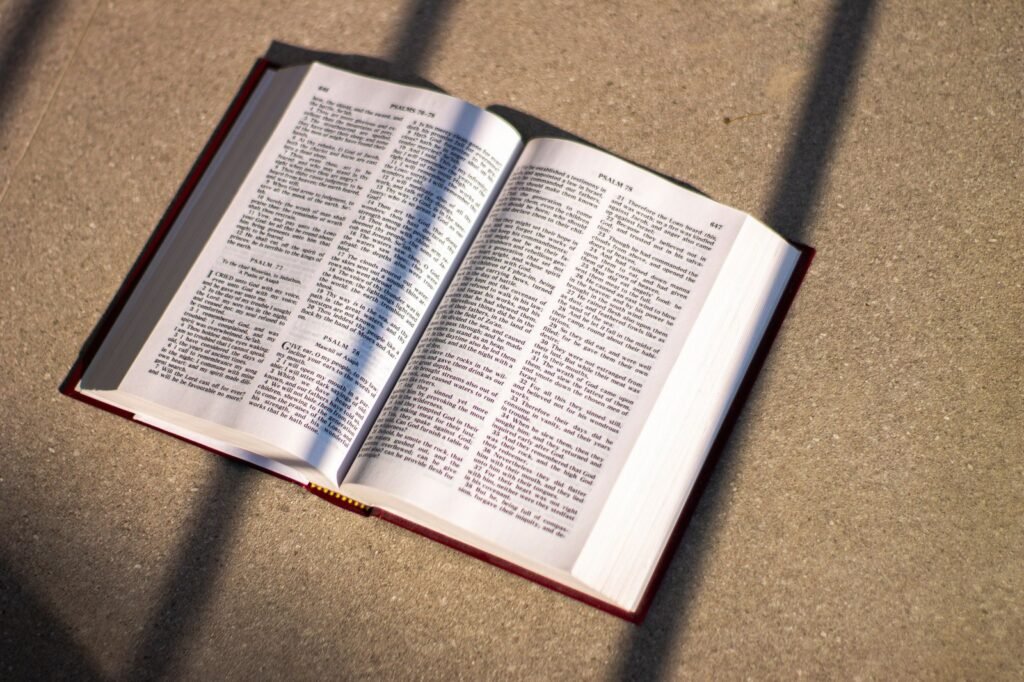
Under each station: the psalms, then the prayers and songs outside the psalms. Pray them as they stand, or use them as the mould for your own words.
① THE GATE, Thanksgiving and Praise
The Psalms
The gate psalms themselves
– 100, Enter into his gates with thanksgiving. The station’s own psalm.
– 24, Lift up your heads, O ye gates. Who may ascend? He that hath clean hands.
– 118, Open to me the gates of righteousness.
– 122, I was glad when they said unto me, Let us go into the house of the LORD.
– 84, A day in thy courts is better than a thousand.
– 95, Come before his presence with thanksgiving.
– 92, A Psalm for the sabbath day. Begins: It is a good thing to give thanks.
Rehearsing what God has done
– 103, Forget not all his benefits. Read it slowly and answer it item by item.
– 107, O give thanks unto the LORD. Four kinds of people He rescued.
– 136, His mercy endureth for ever, twenty-six times. Say it aloud with someone.
– 111 · 116 · 117, short, dense, complete.
– 34, I will bless the LORD at all times. For a season when you do not feel it.
– 65 · 66, harvest, deliverance, and the vow paid.
– 104, creation, in order.
– 145 – 150, the closing Hallel. 150 is the last word of the psalter and it is nothing but praise.
The prayers and songs outside the psalms
| Who | Where | What it is |
|---|---|---|
| Moses and Miriam | Exodus 15:1–21Exodus 15:1–211 Then sang Moses and the children of Israel this song unto the LORD, and spake, saying, I will sing unto the LORD, for he hath triumphed gloriously: the horse and his rider hath he thrown into the sea. 2 The LORD is my strength and song, and he is become my salvation: he is my God, and I will prepare him an habitation; my father's God, and I will exalt him. 3 The LORD is a man of war: the LORD is his name. 4 Pharaoh's chariots and his host hath he cast into the sea: his chosen captains also are drowned in the Red sea. 5 The depths have covered them: they sank into the bottom as a stone. 6 Thy right hand, O LORD, is become glorious in power: thy right hand, O LORD, hath dashed in pieces the enemy. 7 And in the greatness of thine excellency thou hast overthrown them that rose up against thee: thou sentest forth thy wrath, which consumed them as stubble. 8 And with the blast of thy nostrils the waters were gathered together, the floods stood upright as an heap, and the depths were congealed in the heart of the sea. 9 The enemy said, I will pursue, I will overtake, I will divide the spoil; my lust shall be satisfied upon them; I will draw my sword, my hand shall destroy them.King James Version | The first song in Scripture, sung after the sea |
| Deborah and Barak | Judges 5 | Victory, and the names of who showed up |
| Hannah | 1 Samuel 2:1–101 Samuel 2:1–101 And Hannah prayed, and said, My heart rejoiceth in the LORD, mine horn is exalted in the LORD: my mouth is enlarged over mine enemies; because I rejoice in thy salvation. 2 There is none holy as the LORD: for there is none beside thee: neither is there any rock like our God. 3 Talk no more so exceeding proudly; let not arrogancy come out of your mouth: for the LORD is a God of knowledge, and by him actions are weighed. 4 The bows of the mighty men are broken, and they that stumbled are girded with strength. 5 They that were full have hired out themselves for bread; and they that were hungry ceased: so that the barren hath born seven; and she that hath many children is waxed feeble. 6 The LORD killeth, and maketh alive: he bringeth down to the grave, and bringeth up. 7 The LORD maketh poor, and maketh rich: he bringeth low, and lifteth up. 8 He raiseth up the poor out of the dust, and lifteth up the beggar from the dunghill, to set them among princes, and to make them inherit the throne of glory: for the pillars of the earth are the LORD'S, and he hath set the world upon them. 9 He will keep the feet of his saints, and the wicked shall be silent in darkness; for by strength shall no man prevail.King James Version | The barren woman’s song. The pattern for the Magnificat |
| David | 1 Chronicles 16:8–361 Chronicles 16:8–368 Give thanks unto the LORD, call upon his name, make known his deeds among the people. 9 Sing unto him, sing psalms unto him, talk ye of all his wondrous works. 10 Glory ye in his holy name: let the heart of them rejoice that seek the LORD. 11 Seek the LORD and his strength, seek his face continually. 12 Remember his marvellous works that he hath done, his wonders, and the judgments of his mouth; 13 O ye seed of Israel his servant, ye children of Jacob, his chosen ones. 14 He is the LORD our God; his judgments are in all the earth. 15 Be ye mindful always of his covenant; the word which he commanded to a thousand generations; 16 Even of the covenant which he made with Abraham, and of his oath unto Isaac;King James Version | Sung when the ark came home |
| David | 1 Chronicles 29:10–131 Chronicles 29:10–1310 Wherefore David blessed the LORD before all the congregation: and David said, Blessed be thou, LORD God of Israel our father, for ever and ever. 11 Thine, O LORD, is the greatness, and the power, and the glory, and the victory, and the majesty: for all that is in the heaven and in the earth is thine; thine is the kingdom, O LORD, and thou art exalted as head above all. 12 Both riches and honour come of thee, and thou reignest over all; and in thine hand is power and might; and in thine hand it is to make great, and to give strength unto all. 13 Now therefore, our God, we thank thee, and praise thy glorious name.King James Version | Thine, O LORD, is the greatness, at the offering for the temple |
| Mary | Luke 1:46–55Luke 1:46–5546 And Mary said, My soul doth magnify the Lord, 47 And my spirit hath rejoiced in God my Saviour. 48 For he hath regarded the low estate of his handmaiden: for, behold, from henceforth all generations shall call me blessed. 49 For he that is mighty hath done to me great things; and holy is his name. 50 And his mercy is on them that fear him from generation to generation. 51 He hath shewed strength with his arm; he hath scattered the proud in the imagination of their hearts. 52 He hath put down the mighty from their seats, and exalted them of low degree. 53 He hath filled the hungry with good things; and the rich he hath sent empty away. 54 He hath holpen his servant Israel, in remembrance of his mercy;King James Version | The Magnificat |
| Zacharias | Luke 1:68–79Luke 1:68–7968 Blessed be the Lord God of Israel; for he hath visited and redeemed his people, 69 And hath raised up an horn of salvation for us in the house of his servant David; 70 As he spake by the mouth of his holy prophets, which have been since the world began: 71 That we should be saved from our enemies, and from the hand of all that hate us; 72 To perform the mercy promised to our fathers, and to remember his holy covenant; 73 The oath which he sware to our father Abraham, 74 That he would grant unto us, that we being delivered out of the hand of our enemies might serve him without fear, 75 In holiness and righteousness before him, all the days of our life. 76 And thou, child, shalt be called the prophet of the Highest: for thou shalt go before the face of the Lord to prepare his ways;King James Version | The Benedictus, after nine months of silence |
| Elizabeth | Luke 1:42–45Luke 1:42–4542 And she spake out with a loud voice, and said, Blessed art thou among women, and blessed is the fruit of thy womb. 43 And whence is this to me, that the mother of my Lord should come to me? 44 For, lo, as soon as the voice of thy salutation sounded in mine ears, the babe leaped in my womb for joy. 45 And blessed is she that believed: for there shall be a performance of those things which were told her from the Lord.King James Version | Blessing, spoken over another |
| Simeon | Luke 2:29–32Luke 2:29–3229 Lord, now lettest thou thy servant depart in peace, according to thy word: 30 For mine eyes have seen thy salvation, 31 Which thou hast prepared before the face of all people; 32 A light to lighten the Gentiles, and the glory of thy people Israel.King James Version | Now lettest thou thy servant depart in peace |
| Melchizedek | Genesis 14:19–20Genesis 14:19–2019 And he blessed him, and said, Blessed be Abram of the most high God, possessor of heaven and earth: 20 And blessed be the most high God, which hath delivered thine enemies into thy hand. And he gave him tithes of all.King James Version | The first recorded blessing of God by a priest |
| Jethro | Exodus 18:10Exodus 18:10And Jethro said, Blessed be the LORD, who hath delivered you out of the hand of the Egyptians, and out of the hand of Pharaoh, who hath delivered the people from under the hand of the Egyptians.King James Version | A foreigner blessing the God of Israel |
| Job | Job 1:21Job 1:21And said, Naked came I out of my mother's womb, and naked shall I return thither: the LORD gave, and the LORD hath taken away; blessed be the name of the LORD.King James Version | Thanksgiving in the hour of loss |
| Jonah | Jonah 2:1–9Jonah 2:1–91 Then Jonah prayed unto the LORD his God out of the fish's belly, 2 And said, I cried by reason of mine affliction unto the LORD, and he heard me; out of the belly of hell cried I, and thou heardest my voice. 3 For thou hadst cast me into the deep, in the midst of the seas; and the floods compassed me about: all thy billows and thy waves passed over me. 4 Then I said, I am cast out of thy sight; yet I will look again toward thy holy temple. 5 The waters compassed me about, even to the soul: the depth closed me round about, the weeds were wrapped about my head. 6 I went down to the bottoms of the mountains; the earth with her bars was about me for ever: yet hast thou brought up my life from corruption, O LORD my God. 7 When my soul fainted within me I remembered the LORD: and my prayer came in unto thee, into thine holy temple. 8 They that observe lying vanities forsake their own mercy. 9 But I will sacrifice unto thee with the voice of thanksgiving; I will pay that that I have vowed. Salvation is of the LORD.King James Version | Thanksgiving from inside the fish, before deliverance |
| Habakkuk | Habakkuk 3:17–19Habakkuk 3:17–1917 Although the fig tree shall not blossom, neither shall fruit be in the vines; the labour of the olive shall fail, and the fields shall yield no meat; the flock shall be cut off from the fold, and there shall be no herd in the stalls: 18 Yet I will rejoice in the LORD, I will joy in the God of my salvation. 19 The LORD God is my strength, and he will make my feet like hinds' feet, and he will make me to walk upon mine high places. To the chief singer on my stringed instruments.King James Version | Although the fig tree shall not blossom… yet will I rejoice |
| Nehemiah and the Levites | Nehemiah 9:5–6Nehemiah 9:5–65 Then the Levites, Jeshua, and Kadmiel, Bani, Hashabniah, Sherebiah, Hodijah, Shebaniah, and Pethahiah, said, Stand up and bless the LORD your God for ever and ever: and blessed be thy glorious name, which is exalted above all blessing and praise. 6 Thou, even thou, art LORD alone; thou hast made heaven, the heaven of heavens, with all their host, the earth, and all things that are therein, the seas, and all that is therein, and thou preservest them all; and the host of heaven worshippeth thee.King James Version | Stand up and bless the LORD your God for ever and ever |
| Heaven | Revelation 4:11Revelation 4:11Thou art worthy, O Lord, to receive glory and honour and power: for thou hast created all things, and for thy pleasure they are and were created.King James Version · 5:9–14 · 7:12 | The songs already being sung |
| The redeemed | Revelation 15:3–4Revelation 15:3–43 And they sing the song of Moses the servant of God, and the song of the Lamb, saying, Great and marvellous are thy works, Lord God Almighty; just and true are thy ways, thou King of saints. 4 Who shall not fear thee, O Lord, and glorify thy name? for thou only art holy: for all nations shall come and worship before thee; for thy judgments are made manifest.King James Version | The song of Moses and the Lamb |
② THE ALTAR OF SACRIFICE, Confession
The Psalms
The seven penitential psalms. The church has prayed these together for sixteen centuries. Learn them.
- 6, the first cry, out of exhaustion
- 32, Blessed is he whose transgression is forgiven. The relief of confession, and what silence cost him
- 38, the physical weight of unconfessed sin
- 51, David after Bathsheba. If you learn one, learn this one
- 102, the prayer of the afflicted, when he is overwhelmed
- 130, Out of the depths have I cried unto thee. Six verses. Perfect for reading aloud
- 143, Enter not into judgment with thy servant
Also
– 25, Remember not the sins of my youth.
– 40:12, Mine iniquities have taken hold upon me, so that I am not able to look up.
– 69, the psalm of reproach, quoted more in the New Testament than almost any other
– 79:8–9, Remember not against us former iniquities.
The prayers outside the psalms
| Who | Where | Note |
|---|---|---|
| Daniel | Daniel 9:4–19Daniel 9:4–194 And I prayed unto the LORD my God, and made my confession, and said, O Lord, the great and dreadful God, keeping the covenant and mercy to them that love him, and to them that keep his commandments; 5 We have sinned, and have committed iniquity, and have done wickedly, and have rebelled, even by departing from thy precepts and from thy judgments: 6 Neither have we hearkened unto thy servants the prophets, which spake in thy name to our kings, our princes, and our fathers, and to all the people of the land. 7 O Lord, righteousness belongeth unto thee, but unto us confusion of faces, as at this day; to the men of Judah, and to the inhabitants of Jerusalem, and unto all Israel, that are near, and that are far off, through all the countries whither thou hast driven them, because of their trespass that they have trespassed against thee. 8 O Lord, to us belongeth confusion of face, to our kings, to our princes, and to our fathers, because we have sinned against thee. 9 To the Lord our God belong mercies and forgivenesses, though we have rebelled against him; 10 Neither have we obeyed the voice of the LORD our God, to walk in his laws, which he set before us by his servants the prophets. 11 Yea, all Israel have transgressed thy law, even by departing, that they might not obey thy voice; therefore the curse is poured upon us, and the oath that is written in the law of Moses the servant of God, because we have sinned against him. 12 And he hath confirmed his words, which he spake against us, and against our judges that judged us, by bringing upon us a great evil: for under the whole heaven hath not been done as hath been done upon Jerusalem.King James Version | The greatest confession in Scripture. Notice he says we, though he had done nothing |
| Ezra | Ezra 9:5–15Ezra 9:5–155 And at the evening sacrifice I arose up from my heaviness; and having rent my garment and my mantle, I fell upon my knees, and spread out my hands unto the LORD my God, 6 And said, O my God, I am ashamed and blush to lift up my face to thee, my God: for our iniquities are increased over our head, and our trespass is grown up unto the heavens. 7 Since the days of our fathers have we been in a great trespass unto this day; and for our iniquities have we, our kings, and our priests, been delivered into the hand of the kings of the lands, to the sword, to captivity, and to a spoil, and to confusion of face, as it is this day. 8 And now for a little space grace hath been shewed from the LORD our God, to leave us a remnant to escape, and to give us a nail in his holy place, that our God may lighten our eyes, and give us a little reviving in our bondage. 9 For we were bondmen; yet our God hath not forsaken us in our bondage, but hath extended mercy unto us in the sight of the kings of Persia, to give us a reviving, to set up the house of our God, and to repair the desolations thereof, and to give us a wall in Judah and in Jerusalem. 10 And now, O our God, what shall we say after this? for we have forsaken thy commandments, 11 Which thou hast commanded by thy servants the prophets, saying, The land, unto which ye go to possess it, is an unclean land with the filthiness of the people of the lands, with their abominations, which have filled it from one end to another with their uncleanness. 12 Now therefore give not your daughters unto their sons, neither take their daughters unto your sons, nor seek their peace or their wealth for ever: that ye may be strong, and eat the good of the land, and leave it for an inheritance to your children for ever. 13 And after all that is come upon us for our evil deeds, and for our great trespass, seeing that thou our God hast punished us less than our iniquities deserve, and hast given us such deliverance as this;King James Version | I am ashamed and blush to lift up my face |
| Nehemiah | Nehemiah 1:4–11Nehemiah 1:4–114 And it came to pass, when I heard these words, that I sat down and wept, and mourned certain days, and fasted, and prayed before the God of heaven, 5 And said, I beseech thee, O LORD God of heaven, the great and terrible God, that keepeth covenant and mercy for them that love him and observe his commandments: 6 Let thine ear now be attentive, and thine eyes open, that thou mayest hear the prayer of thy servant, which I pray before thee now, day and night, for the children of Israel thy servants, and confess the sins of the children of Israel, which we have sinned against thee: both I and my father's house have sinned. 7 We have dealt very corruptly against thee, and have not kept the commandments, nor the statutes, nor the judgments, which thou commandedst thy servant Moses. 8 Remember, I beseech thee, the word that thou commandedst thy servant Moses, saying, If ye transgress, I will scatter you abroad among the nations: 9 But if ye turn unto me, and keep my commandments, and do them; though there were of you cast out unto the uttermost part of the heaven, yet will I gather them from thence, and will bring them unto the place that I have chosen to set my name there. 10 Now these are thy servants and thy people, whom thou hast redeemed by thy great power, and by thy strong hand. 11 O Lord, I beseech thee, let now thine ear be attentive to the prayer of thy servant, and to the prayer of thy servants, who desire to fear thy name: and prosper, I pray thee, thy servant this day, and grant him mercy in the sight of this man. For I was the king's cupbearer.King James Version | Confessed his father’s house and himself by name |
| The Levites | Nehemiah 9:16–38Nehemiah 9:16–3816 But they and our fathers dealt proudly, and hardened their necks, and hearkened not to thy commandments, 17 And refused to obey, neither were mindful of thy wonders that thou didst among them; but hardened their necks, and in their rebellion appointed a captain to return to their bondage: but thou art a God ready to pardon, gracious and merciful, slow to anger, and of great kindness, and forsookest them not. 18 Yea, when they had made them a molten calf, and said, This is thy God that brought thee up out of Egypt, and had wrought great provocations; 19 Yet thou in thy manifold mercies forsookest them not in the wilderness: the pillar of the cloud departed not from them by day, to lead them in the way; neither the pillar of fire by night, to shew them light, and the way wherein they should go. 20 Thou gavest also thy good spirit to instruct them, and withheldest not thy manna from their mouth, and gavest them water for their thirst. 21 Yea, forty years didst thou sustain them in the wilderness, so that they lacked nothing; their clothes waxed not old, and their feet swelled not. 22 Moreover thou gavest them kingdoms and nations, and didst divide them into corners: so they possessed the land of Sihon, and the land of the king of Heshbon, and the land of Og king of Bashan. 23 Their children also multipliedst thou as the stars of heaven, and broughtest them into the land, concerning which thou hadst promised to their fathers, that they should go in to possess it. 24 So the children went in and possessed the land, and thou subduedst before them the inhabitants of the land, the Canaanites, and gavest them into their hands, with their kings, and the people of the land, that they might do with them as they would.King James Version | A national history, told as a confession |
| Moses | Exodus 32:31–32Exodus 32:31–3231 And Moses returned unto the LORD, and said, Oh, this people have sinned a great sin, and have made them gods of gold. 32 Yet now, if thou wilt forgive their sin-; and if not, blot me, I pray thee, out of thy book which thou hast written.King James Version | Blot me out of thy book, confession that offers to pay |
| Solomon | 1 Kings 8:46–501 Kings 8:46–5046 If they sin against thee, (for there is no man that sinneth not,) and thou be angry with them, and deliver them to the enemy, so that they carry them away captives unto the land of the enemy, far or near; 47 Yet if they shall bethink themselves in the land whither they were carried captives, and repent, and make supplication unto thee in the land of them that carried them captives, saying, We have sinned, and have done perversely, we have committed wickedness; 48 And so return unto thee with all their heart, and with all their soul, in the land of their enemies, which led them away captive, and pray unto thee toward their land, which thou gavest unto their fathers, the city which thou hast chosen, and the house which I have built for thy name: 49 Then hear thou their prayer and their supplication in heaven thy dwelling place, and maintain their cause, 50 And forgive thy people that have sinned against thee, and all their transgressions wherein they have transgressed against thee, and give them compassion before them who carried them captive, that they may have compassion on them:King James Version | Written in advance, for a people not yet fallen |
| David | 2 Samuel 12:132 Samuel 12:13And David said unto Nathan, I have sinned against the LORD. And Nathan said unto David, The LORD also hath put away thy sin; thou shalt not die.King James Version | Four words: I have sinned against the LORD |
| Job | Job 42:1–6Job 42:1–61 Then Job answered the LORD, and said, 2 I know that thou canst do every thing, and that no thought can be withholden from thee. 3 Who is he that hideth counsel without knowledge? therefore have I uttered that I understood not; things too wonderful for me, which I knew not. 4 Hear, I beseech thee, and I will speak: I will demand of thee, and declare thou unto me. 5 I have heard of thee by the hearing of the ear: but now mine eye seeth thee. 6 Wherefore I abhor myself, and repent in dust and ashes.King James Version | I abhor myself, and repent in dust and ashes |
| Isaiah | Isaiah 6:5Isaiah 6:5Then said I, Woe is me! for I am undone; because I am a man of unclean lips, and I dwell in the midst of a people of unclean lips: for mine eyes have seen the King, the LORD of hosts.King James Version | Woe is me! for I am undone, said by the holiest man in the book |
| Peter | Luke 5:8Luke 5:8When Simon Peter saw it, he fell down at Jesus' knees, saying, Depart from me; for I am a sinful man, O Lord.King James Version | Depart from me; for I am a sinful man, O Lord |
| The publican | Luke 18:13Luke 18:13And the publican, standing afar off, would not lift up so much as his eyes unto heaven, but smote upon his breast, saying, God be merciful to me a sinner.King James Version | Seven words, and he went home justified |
| The prodigal | Luke 15:18–19Luke 15:18–1918 I will arise and go to my father, and will say unto him, Father, I have sinned against heaven, and before thee, 19 And am no more worthy to be called thy son: make me as one of thy hired servants.King James Version | Rehearsed on the road. Confession with no bargaining left |
| The thief | Luke 23:41–42Luke 23:41–4241 And we indeed justly; for we receive the due reward of our deeds: but this man hath done nothing amiss. 42 And he said unto Jesus, Lord, remember me when thou comest into thy kingdom.King James Version | We receive the due reward of our deeds |
| Achan | Joshua 7:20Joshua 7:20And Achan answered Joshua, and said, Indeed I have sinned against the LORD God of Israel, and thus and thus have I done:King James Version | Confession that came too late to save him, but was still true |
| Jeremiah | Jeremiah 14:7Jeremiah 14:7O LORD, though our iniquities testify against us, do thou it for thy name's sake: for our backslidings are many; we have sinned against thee.King James Version, 20 | We acknowledge our wickedness |
| Jeremiah | Lamentations 3:40–42Lamentations 3:40–4240 Let us search and try our ways, and turn again to the LORD. 41 Let us lift up our heart with our hands unto God in the heavens. 42 We have transgressed and have rebelled: thou hast not pardoned.King James Version | Let us search and try our ways, and turn again |
③ THE LAVER, Cleansing
The Psalms
- 51:7, 10, Purge me with hyssop… Create in me a clean heart. The laver’s own verse.
- 19:12–14, Cleanse thou me from secret faults. The prayer for what you cannot see in yourself
- 139:23–24, Search me, O God… see if there be any wicked way in me
- 119:9, Wherewithal shall a young man cleanse his way? And the answer, in the same verse
- 24:3–4, He that hath clean hands, and a pure heart
- 26:2, Examine me, O LORD, and prove me; try my reins and my heart
- 86:11, Unite my heart to fear thy name. For a divided man
- 141:3–4, Set a watch, O LORD, before my mouth
- 101, a psalm of resolutions about what you will allow in your house
The passages to pray
| Who | Where | Note |
|---|---|---|
| Isaiah | Isaiah 6:6–7Isaiah 6:6–76 Then flew one of the seraphims unto me, having a live coal in his hand, which he had taken with the tongs from off the altar: 7 And he laid it upon my mouth, and said, Lo, this hath touched thy lips; and thine iniquity is taken away, and thy sin purged.King James Version | The live coal, taken from the altar, applied to the lips. Altar first, then cleansing |
| Ezekiel | Ezekiel 36:25–27Ezekiel 36:25–2725 Then will I sprinkle clean water upon you, and ye shall be clean: from all your filthiness, and from all your idols, will I cleanse you. 26 A new heart also will I give you, and a new spirit will I put within you: and I will take away the stony heart out of your flesh, and I will give you an heart of flesh. 27 And I will put my spirit within you, and cause you to walk in my statutes, and ye shall keep my judgments, and do them.King James Version | I will sprinkle clean water upon you… a new heart also will I give you |
| Joshua the high priest | Zechariah 3:1–5Zechariah 3:1–51 And he shewed me Joshua the high priest standing before the angel of the LORD, and Satan standing at his right hand to resist him. 2 And the LORD said unto Satan, The LORD rebuke thee, O Satan; even the LORD that hath chosen Jerusalem rebuke thee: is not this a brand plucked out of the fire? 3 Now Joshua was clothed with filthy garments, and stood before the angel. 4 And he answered and spake unto those that stood before him, saying, Take away the filthy garments from him. And unto him he said, Behold, I have caused thine iniquity to pass from thee, and I will clothe thee with change of raiment. 5 And I said, Let them set a fair mitre upon his head. So they set a fair mitre upon his head, and clothed him with garments. And the angel of the LORD stood by.King James Version | Filthy garments removed while Satan stands accusing |
| Naaman | 2 Kings 5:10–142 Kings 5:10–1410 And Elisha sent a messenger unto him, saying, Go and wash in Jordan seven times, and thy flesh shall come again to thee, and thou shalt be clean. 11 But Naaman was wroth, and went away, and said, Behold, I thought, He will surely come out to me, and stand, and call on the name of the LORD his God, and strike his hand over the place, and recover the leper. 12 Are not Abana and Pharpar, rivers of Damascus, better than all the waters of Israel? may I not wash in them, and be clean? So he turned and went away in a rage. 13 And his servants came near, and spake unto him, and said, My father, if the prophet had bid thee do some great thing, wouldest thou not have done it? how much rather then, when he saith to thee, Wash, and be clean? 14 Then went he down, and dipped himself seven times in Jordan, according to the saying of the man of God: and his flesh came again like unto the flesh of a little child, and he was clean.King James Version | Cleansing offered in a form he found insulting |
| Christ | John 13:5–10John 13:5–105 After that he poureth water into a bason, and began to wash the disciples' feet, and to wipe them with the towel wherewith he was girded. 6 Then cometh he to Simon Peter: and Peter saith unto him, Lord, dost thou wash my feet? 7 Jesus answered and said unto him, What I do thou knowest not now; but thou shalt know hereafter. 8 Peter saith unto him, Thou shalt never wash my feet. Jesus answered him, If I wash thee not, thou hast no part with me. 9 Simon Peter saith unto him, Lord, not my feet only, but also my hands and my head. 10 Jesus saith to him, He that is washed needeth not save to wash his feet, but is clean every whit: and ye are clean, but not all.King James Version | He that is washed needeth not save to wash his feet |
| John | 1 John 1:7–91 John 1:7–97 But if we walk in the light, as he is in the light, we have fellowship one with another, and the blood of Jesus Christ his Son cleanseth us from all sin. 8 If we say that we have no sin, we deceive ourselves, and the truth is not in us. 9 If we confess our sins, he is faithful and just to forgive us our sins, and to cleanse us from all unrighteousness.King James Version | The two verbs: forgive, and cleanse |
| Paul | Titus 3:5Titus 3:5Not by works of righteousness which we have done, but according to his mercy he saved us, by the washing of regeneration, and renewing of the Holy Ghost;King James Version · Ephesians 5:26Ephesians 5:26That he might sanctify and cleanse it with the washing of water by the word,King James Version | The washing of regeneration; water by the word |
| James | James 4:8James 4:8Draw nigh to God, and he will draw nigh to you. Cleanse your hands, ye sinners; and purify your hearts, ye double minded.King James Version | Cleanse your hands… purify your hearts, ye double minded |
④ THE LAMPSTAND, The Spirit Given, the Light Shining
The Psalms
Asking for light
– 43:3, O send out thy light and thy truth: let them lead me
– 27:1, The LORD is my light and my salvation
– 36:9, In thy light shall we see light
– 119:105, 130, a lamp unto my feet; the entrance of thy words giveth light
– 18:28, Thou wilt light my candle
– 4:6, Lift thou up the light of thy countenance upon us
Asking for the Spirit
– 51:11–12, Take not thy holy spirit from me… uphold me with thy free spirit. The only place in the Old Testament a man prays this
– 143:10, Thy spirit is good; lead me into the land of uprightness
– 139:23–24, searched, and then led
The passages to pray
| Who | Where | Note |
|---|---|---|
| Zechariah | Zechariah 4:1–14Zechariah 4:1–141 And the angel that talked with me came again, and waked me, as a man that is wakened out of his sleep, 2 And said unto me, What seest thou? And I said, I have looked, and behold a candlestick all of gold, with a bowl upon the top of it, and his seven lamps thereon, and seven pipes to the seven lamps, which are upon the top thereof: 3 And two olive trees by it, one upon the right side of the bowl, and the other upon the left side thereof. 4 So I answered and spake to the angel that talked with me, saying, What are these, my lord? 5 Then the angel that talked with me answered and said unto me, Knowest thou not what these be? And I said, No, my lord. 6 Then he answered and spake unto me, saying, This is the word of the LORD unto Zerubbabel, saying, Not by might, nor by power, but by my spirit, saith the LORD of hosts. 7 Who art thou, O great mountain? before Zerubbabel thou shalt become a plain: and he shall bring forth the headstone thereof with shoutings, crying, Grace, grace unto it. 8 Moreover the word of the LORD came unto me, saying, 9 The hands of Zerubbabel have laid the foundation of this house; his hands shall also finish it; and thou shalt know that the LORD of hosts hath sent me unto you.King James Version | The lampstand fed by two olive trees. Not by might, nor by power |
| Elisha | 2 Kings 6:15–172 Kings 6:15–1715 And when the servant of the man of God was risen early, and gone forth, behold, an host compassed the city both with horses and chariots. And his servant said unto him, Alas, my master! how shall we do? 16 And he answered, Fear not: for they that be with us are more than they that be with them. 17 And Elisha prayed, and said, LORD, I pray thee, open his eyes, that he may see. And the LORD opened the eyes of the young man; and he saw: and, behold, the mountain was full of horses and chariots of fire round about Elisha.King James Version | LORD, I pray thee, open his eyes. Pray this over someone who cannot see |
| Elisha | 2 Kings 2:92 Kings 2:9And it came to pass, when they were gone over, that Elijah said unto Elisha, Ask what I shall do for thee, before I be taken away from thee. And Elisha said, I pray thee, let a double portion of thy spirit be upon me.King James Version | Let a double portion of thy spirit be upon me |
| Christ | John 14:16–17John 14:16–1716 And I will pray the Father, and he shall give you another Comforter, that he may abide with you for ever; 17 Even the Spirit of truth; whom the world cannot receive, because it seeth him not, neither knoweth him: but ye know him; for he dwelleth with you, and shall be in you.King James Version, 26 · 16:13 | The Comforter promised, and what He will do |
| Christ | Luke 11:13Luke 11:13If ye then, being evil, know how to give good gifts unto your children: how much more shall your heavenly Father give the Holy Spirit to them that ask him?King James Version | How much more shall your heavenly Father give the Holy Spirit |
| The church | Acts 4:29–31Acts 4:29–3129 And now, Lord, behold their threatenings: and grant unto thy servants, that with all boldness they may speak thy word, 30 By stretching forth thine hand to heal; and that signs and wonders may be done by the name of thy holy child Jesus. 31 And when they had prayed, the place was shaken where they were assembled together; and they were all filled with the Holy Ghost, and they spake the word of God with boldness.King James Version | Prayed for boldness, not safety. The place was shaken |
| Paul | Ephesians 1:17–19Ephesians 1:17–1917 That the God of our Lord Jesus Christ, the Father of glory, may give unto you the spirit of wisdom and revelation in the knowledge of him: 18 The eyes of your understanding being enlightened; that ye may know what is the hope of his calling, and what the riches of the glory of his inheritance in the saints, 19 And what is the exceeding greatness of his power to us-ward who believe, according to the working of his mighty power,King James Version | The spirit of wisdom and revelation… the eyes of your understanding being enlightened |
| Paul | Ephesians 3:14–21Ephesians 3:14–2114 For this cause I bow my knees unto the Father of our Lord Jesus Christ, 15 Of whom the whole family in heaven and earth is named, 16 That he would grant you, according to the riches of his glory, to be strengthened with might by his Spirit in the inner man; 17 That Christ may dwell in your hearts by faith; that ye, being rooted and grounded in love, 18 May be able to comprehend with all saints what is the breadth, and length, and depth, and height; 19 And to know the love of Christ, which passeth knowledge, that ye might be filled with all the fulness of God. 20 Now unto him that is able to do exceeding abundantly above all that we ask or think, according to the power that worketh in us, 21 Unto him be glory in the church by Christ Jesus throughout all ages, world without end. Amen.King James Version | Strengthened with might by his Spirit in the inner man |
| Aaron | Numbers 6:24–26Numbers 6:24–2624 The LORD bless thee, and keep thee: 25 The LORD make his face shine upon thee, and be gracious unto thee: 26 The LORD lift up his countenance upon thee, and give thee peace.King James Version | The LORD make his face shine upon thee |
| Christ | Matthew 5:14–16Matthew 5:14–1614 Ye are the light of the world. A city that is set on an hill cannot be hid. 15 Neither do men light a candle, and put it under a bushel, but on a candlestick; and it giveth light unto all that are in the house. 16 Let your light so shine before men, that they may see your good works, and glorify your Father which is in heaven.King James Version | The shining half of the station |
| Christ | Acts 1:8Acts 1:8But ye shall receive power, after that the Holy Ghost is come upon you: and ye shall be witnesses unto me both in Jerusalem, and in all Judaea, and in Samaria, and unto the uttermost part of the earth.King James Version | Power, then witness. In that order |
⑤ THE TABLE OF SHEWBREAD, The Word, and What He Provides
The Psalms
The Word psalms
– 119, the whole psalm, all 176 verses, is about the Word. Take it eight verses at a time, one letter of the alphabet per day, and it will last you three weeks
– 119:18, Open thou mine eyes, that I may behold wondrous things out of thy law. Pray this before you read anything
– 119:103, Sweeter also than honey to my mouth
– 19:7–11, the law, testimony, statutes, commandment, fear, judgments. Six words, six verbs, one answer
– 1, His delight is in the law of the LORD
The table and the feeding
– 23:5, Thou preparest a table before me
– 78:19–25, Can God furnish a table in the wilderness? And He did, man did eat angels’ food
– 34:8, O taste and see that the LORD is good
– 42:1–2, As the hart panteth after the water brooks
– 63:1–5, My soul shall be satisfied as with marrow and fatness
– 81:10, Open thy mouth wide, and I will fill it
– 145:15–16, Thou openest thine hand, and satisfiest the desire of every living thing
The passages to pray
| Who | Where | Note |
|---|---|---|
| Christ | Matthew 6:11Matthew 6:11Give us this day our daily bread.King James Version | Give us this day our daily bread. Asked at the incense, answered here |
| Christ | Matthew 4:4Matthew 4:4But he answered and said, It is written, Man shall not live by bread alone, but by every word that proceedeth out of the mouth of God.King James Version | Man shall not live by bread alone |
| Christ | John 6:32–58John 6:32–5832 Then Jesus said unto them, Verily, verily, I say unto you, Moses gave you not that bread from heaven; but my Father giveth you the true bread from heaven. 33 For the bread of God is he which cometh down from heaven, and giveth life unto the world. 34 Then said they unto him, Lord, evermore give us this bread. 35 And Jesus said unto them, I am the bread of life: he that cometh to me shall never hunger; and he that believeth on me shall never thirst. 36 But I said unto you, That ye also have seen me, and believe not. 37 All that the Father giveth me shall come to me; and him that cometh to me I will in no wise cast out. 38 For I came down from heaven, not to do mine own will, but the will of him that sent me. 39 And this is the Father's will which hath sent me, that of all which he hath given me I should lose nothing, but should raise it up again at the last day. 40 And this is the will of him that sent me, that every one which seeth the Son, and believeth on him, may have everlasting life: and I will raise him up at the last day.King James Version | The bread of life. Read it standing at this station |
| Agur | Proverbs 30:7–9Proverbs 30:7–97 Two things have I required of thee; deny me them not before I die: 8 Remove far from me vanity and lies: give me neither poverty nor riches; feed me with food convenient for me: 9 Lest I be full, and deny thee, and say, Who is the LORD? or lest I be poor, and steal, and take the name of my God in vain.King James Version | Feed me with food convenient for me. The wisest prayer about money in Scripture |
| Jeremiah | Jeremiah 15:16Jeremiah 15:16Thy words were found, and I did eat them; and thy word was unto me the joy and rejoicing of mine heart: for I am called by thy name, O LORD God of hosts.King James Version | Thy words were found, and I did eat them |
| Ezekiel | Ezekiel 3:1–3Ezekiel 3:1–31 Moreover he said unto me, Son of man, eat that thou findest; eat this roll, and go speak unto the house of Israel. 2 So I opened my mouth, and he caused me to eat that roll. 3 And he said unto me, Son of man, cause thy belly to eat, and fill thy bowels with this roll that I give thee. Then did I eat it; and it was in my mouth as honey for sweetness.King James Version | Eat this roll… and it was in my mouth as honey for sweetness |
| Job | Job 23:12Job 23:12Neither have I gone back from the commandment of his lips; I have esteemed the words of his mouth more than my necessary food.King James Version | I have esteemed the words of his mouth more than my necessary food |
| Solomon | 1 Kings 3:5–141 Kings 3:5–145 In Gibeon the LORD appeared to Solomon in a dream by night: and God said, Ask what I shall give thee. 6 And Solomon said, Thou hast shewed unto thy servant David my father great mercy, according as he walked before thee in truth, and in righteousness, and in uprightness of heart with thee; and thou hast kept for him this great kindness, that thou hast given him a son to sit on his throne, as it is this day. 7 And now, O LORD my God, thou hast made thy servant king instead of David my father: and I am but a little child: I know not how to go out or come in. 8 And thy servant is in the midst of thy people which thou hast chosen, a great people, that cannot be numbered nor counted for multitude. 9 Give therefore thy servant an understanding heart to judge thy people, that I may discern between good and bad: for who is able to judge this thy so great a people? 10 And the speech pleased the Lord, that Solomon had asked this thing. 11 And God said unto him, Because thou hast asked this thing, and hast not asked for thyself long life; neither hast asked riches for thyself, nor hast asked the life of thine enemies; but hast asked for thyself understanding to discern judgment; 12 Behold, I have done according to thy words: lo, I have given thee a wise and an understanding heart; so that there was none like thee before thee, neither after thee shall any arise like unto thee. 13 And I have also given thee that which thou hast not asked, both riches, and honour: so that there shall not be any among the kings like unto thee all thy days.King James Version | Asked for an understanding heart, and got everything else besides |
| James | James 1:5James 1:5If any of you lack wisdom, let him ask of God, that giveth to all men liberally, and upbraideth not; and it shall be given him.King James Version | If any of you lack wisdom, let him ask of God |
| Paul | Colossians 1:9–12Colossians 1:9–129 For this cause we also, since the day we heard it, do not cease to pray for you, and to desire that ye might be filled with the knowledge of his will in all wisdom and spiritual understanding; 10 That ye might walk worthy of the Lord unto all pleasing, being fruitful in every good work, and increasing in the knowledge of God; 11 Strengthened with all might, according to his glorious power, unto all patience and longsuffering with joyfulness; 12 Giving thanks unto the Father, which hath made us meet to be partakers of the inheritance of the saints in light:King James Version | Filled with the knowledge of his will in all wisdom |
| David | Psalm 143:8Psalm 143:8Cause me to hear thy lovingkindness in the morning; for in thee do I trust: cause me to know the way wherein I should walk; for I lift up my soul unto thee.King James Version, 10 | Cause me to know the way… teach me to do thy will |
| Israel | Exodus 16 | Manna. A daily portion, and what happened to those who hoarded |
| Elijah | 1 Kings 19:5–81 Kings 19:5–85 And as he lay and slept under a juniper tree, behold, then an angel touched him, and said unto him, Arise and eat. 6 And he looked, and, behold, there was a cake baken on the coals, and a cruse of water at his head. And he did eat and drink, and laid him down again. 7 And the angel of the LORD came again the second time, and touched him, and said, Arise and eat; because the journey is too great for thee. 8 And he arose, and did eat and drink, and went in the strength of that meat forty days and forty nights unto Horeb the mount of God.King James Version | Fed twice, and went forty days on it |
⑥ THE ALTAR OF INCENSE, Intercession and Petition
The Psalms
On prayer itself
– 141, Let my prayer be set forth before thee as incense. The station’s own psalm
– 5:1–3, My voice shalt thou hear in the morning… and will look up
– 55:17, Evening, and morning, and at noon, will I pray
– 62:8, Pour out your heart before him
– 102, A prayer of the afflicted, when he is overwhelmed, and poureth out his complaint
Crying out
– 61 · 88 · 142 · 143, for the nights when there are no words left
– 130, Out of the depths
– 20, The LORD hear thee in the day of trouble. Pray this over someone
Interceding
– 122:6, Pray for the peace of Jerusalem
– 67, That thy way may be known upon earth, thy saving health among all nations. The missionary psalm
– 72, for those in authority
– 90, Moses’ prayer. Teach us to number our days
The great intercessions
| Who | Where | What to learn from it |
|---|---|---|
| Abraham | Genesis 18:23–33Genesis 18:23–3323 And Abraham drew near, and said, Wilt thou also destroy the righteous with the wicked? 24 Peradventure there be fifty righteous within the city: wilt thou also destroy and not spare the place for the fifty righteous that are therein? 25 That be far from thee to do after this manner, to slay the righteous with the wicked: and that the righteous should be as the wicked, that be far from thee: Shall not the Judge of all the earth do right? 26 And the LORD said, If I find in Sodom fifty righteous within the city, then I will spare all the place for their sakes. 27 And Abraham answered and said, Behold now, I have taken upon me to speak unto the Lord, which am but dust and ashes: 28 Peradventure there shall lack five of the fifty righteous: wilt thou destroy all the city for lack of five? And he said, If I find there forty and five, I will not destroy it. 29 And he spake unto him yet again, and said, Peradventure there shall be forty found there. And he said, I will not do it for forty's sake. 30 And he said unto him, Oh let not the Lord be angry, and I will speak: Peradventure there shall thirty be found there. And he said, I will not do it, if I find thirty there. 31 And he said, Behold now, I have taken upon me to speak unto the Lord: Peradventure there shall be twenty found there. And he said, I will not destroy it for twenty's sake.King James Version | Six times he asked, and God did not once rebuke him for it |
| Jacob | Genesis 32:24–30Genesis 32:24–3024 And Jacob was left alone; and there wrestled a man with him until the breaking of the day. 25 And when he saw that he prevailed not against him, he touched the hollow of his thigh; and the hollow of Jacob's thigh was out of joint, as he wrestled with him. 26 And he said, Let me go, for the day breaketh. And he said, I will not let thee go, except thou bless me. 27 And he said unto him, What is thy name? And he said, Jacob. 28 And he said, Thy name shall be called no more Jacob, but Israel: for as a prince hast thou power with God and with men, and hast prevailed. 29 And Jacob asked him, and said, Tell me, I pray thee, thy name. And he said, Wherefore is it that thou dost ask after my name? And he blessed him there. 30 And Jacob called the name of the place Peniel: for I have seen God face to face, and my life is preserved.King James Version | I will not let thee go, except thou bless me. Prevailing prayer, literally |
| Moses | Exodus 32:11–14Exodus 32:11–1411 And Moses besought the LORD his God, and said, LORD, why doth thy wrath wax hot against thy people, which thou hast brought forth out of the land of Egypt with great power, and with a mighty hand? 12 Wherefore should the Egyptians speak, and say, For mischief did he bring them out, to slay them in the mountains, and to consume them from the face of the earth? Turn from thy fierce wrath, and repent of this evil against thy people. 13 Remember Abraham, Isaac, and Israel, thy servants, to whom thou swarest by thine own self, and saidst unto them, I will multiply your seed as the stars of heaven, and all this land that I have spoken of will I give unto your seed, and they shall inherit it for ever. 14 And the LORD repented of the evil which he thought to do unto his people.King James Version, 31–32 | Argued God’s own reputation back to Him, and the LORD repented |
| Moses | Numbers 14:13–19Numbers 14:13–1913 And Moses said unto the LORD, Then the Egyptians shall hear it, (for thou broughtest up this people in thy might from among them;) 14 And they will tell it to the inhabitants of this land: for they have heard that thou LORD art among this people, that thou LORD art seen face to face, and that thy cloud standeth over them, and that thou goest before them, by day time in a pillar of a cloud, and in a pillar of fire by night. 15 Now if thou shalt kill all this people as one man, then the nations which have heard the fame of thee will speak, saying, 16 Because the LORD was not able to bring this people into the land which he sware unto them, therefore he hath slain them in the wilderness. 17 And now, I beseech thee, let the power of my Lord be great, according as thou hast spoken, saying, 18 The LORD is longsuffering, and of great mercy, forgiving iniquity and transgression, and by no means clearing the guilty, visiting the iniquity of the fathers upon the children unto the third and fourth generation. 19 Pardon, I beseech thee, the iniquity of this people according unto the greatness of thy mercy, and as thou hast forgiven this people, from Egypt even until now.King James Version | The second time. He used God’s own words from Sinai |
| Hannah | 1 Samuel 1:10–181 Samuel 1:10–1810 And she was in bitterness of soul, and prayed unto the LORD, and wept sore. 11 And she vowed a vow, and said, O LORD of hosts, if thou wilt indeed look on the affliction of thine handmaid, and remember me, and not forget thine handmaid, but wilt give unto thine handmaid a man child, then I will give him unto the LORD all the days of his life, and there shall no razor come upon his head. 12 And it came to pass, as she continued praying before the LORD, that Eli marked her mouth. 13 Now Hannah, she spake in her heart; only her lips moved, but her voice was not heard: therefore Eli thought she had been drunken. 14 And Eli said unto her, How long wilt thou be drunken? put away thy wine from thee. 15 And Hannah answered and said, No, my lord, I am a woman of a sorrowful spirit: I have drunk neither wine nor strong drink, but have poured out my soul before the LORD. 16 Count not thine handmaid for a daughter of Belial: for out of the abundance of my complaint and grief have I spoken hitherto. 17 Then Eli answered and said, Go in peace: and the God of Israel grant thee thy petition that thou hast asked of him. 18 And she said, Let thine handmaid find grace in thy sight. So the woman went her way, and did eat, and her countenance was no more sad.King James Version | Prayed until her face changed, before anything else did |
| Samuel | 1 Samuel 12:231 Samuel 12:23Moreover as for me, God forbid that I should sin against the LORD in ceasing to pray for you: but I will teach you the good and the right way:King James Version | God forbid that I should sin against the LORD in ceasing to pray for you |
| Solomon | 1 Kings 8:22–531 Kings 8:22–5322 And Solomon stood before the altar of the LORD in the presence of all the congregation of Israel, and spread forth his hands toward heaven: 23 And he said, LORD God of Israel, there is no God like thee, in heaven above, or on earth beneath, who keepest covenant and mercy with thy servants that walk before thee with all their heart: 24 Who hast kept with thy servant David my father that thou promisedst him: thou spakest also with thy mouth, and hast fulfilled it with thine hand, as it is this day. 25 Therefore now, LORD God of Israel, keep with thy servant David my father that thou promisedst him, saying, There shall not fail thee a man in my sight to sit on the throne of Israel; so that thy children take heed to their way, that they walk before me as thou hast walked before me. 26 And now, O God of Israel, let thy word, I pray thee, be verified, which thou spakest unto thy servant David my father. 27 But will God indeed dwell on the earth? behold, the heaven and heaven of heavens cannot contain thee; how much less this house that I have builded? 28 Yet have thou respect unto the prayer of thy servant, and to his supplication, O LORD my God, to hearken unto the cry and to the prayer, which thy servant prayeth before thee to day: 29 That thine eyes may be open toward this house night and day, even toward the place of which thou hast said, My name shall be there: that thou mayest hearken unto the prayer which thy servant shall make toward this place. 30 And hearken thou to the supplication of thy servant, and of thy people Israel, when they shall pray toward this place: and hear thou in heaven thy dwelling place: and when thou hearest, forgive.King James Version | The dedication. Seven scenarios he prayed for in advance |
| Elijah | 1 Kings 18:36–381 Kings 18:36–3836 And it came to pass at the time of the offering of the evening sacrifice, that Elijah the prophet came near, and said, LORD God of Abraham, Isaac, and of Israel, let it be known this day that thou art God in Israel, and that I am thy servant, and that I have done all these things at thy word. 37 Hear me, O LORD, hear me, that this people may know that thou art the LORD God, and that thou hast turned their heart back again. 38 Then the fire of the LORD fell, and consumed the burnt sacrifice, and the wood, and the stones, and the dust, and licked up the water that was in the trench.King James Version | Sixty-three words, and the fire fell |
| Elijah | James 5:17–18James 5:17–1817 Elias was a man subject to like passions as we are, and he prayed earnestly that it might not rain: and it rained not on the earth by the space of three years and six months. 18 And he prayed again, and the heaven gave rain, and the earth brought forth her fruit.King James Version | A man subject to like passions as we are, that is the point |
| Asa | 2 Chronicles 14:112 Chronicles 14:11And Asa cried unto the LORD his God, and said, LORD, it is nothing with thee to help, whether with many, or with them that have no power: help us, O LORD our God; for we rest on thee, and in thy name we go against this multitude. O LORD, thou art our God; let not man prevail against thee.King James Version | It is nothing with thee to help, whether with many, or with them that have no power |
| Jehoshaphat | 2 Chronicles 20:5–122 Chronicles 20:5–125 And Jehoshaphat stood in the congregation of Judah and Jerusalem, in the house of the LORD, before the new court, 6 And said, O LORD God of our fathers, art not thou God in heaven? and rulest not thou over all the kingdoms of the heathen? and in thine hand is there not power and might, so that none is able to withstand thee? 7 Art not thou our God, who didst drive out the inhabitants of this land before thy people Israel, and gavest it to the seed of Abraham thy friend for ever? 8 And they dwelt therein, and have built thee a sanctuary therein for thy name, saying, 9 If, when evil cometh upon us, as the sword, judgment, or pestilence, or famine, we stand before this house, and in thy presence, (for thy name is in this house,) and cry unto thee in our affliction, then thou wilt hear and help. 10 And now, behold, the children of Ammon and Moab and mount Seir, whom thou wouldest not let Israel invade, when they came out of the land of Egypt, but they turned from them, and destroyed them not; 11 Behold, I say, how they reward us, to come to cast us out of thy possession, which thou hast given us to inherit. 12 O our God, wilt thou not judge them? for we have no might against this great company that cometh against us; neither know we what to do: but our eyes are upon thee.King James Version | We have no might… neither know we what to do: but our eyes are upon thee |
| Hezekiah | 2 Kings 19:14–192 Kings 19:14–1914 And Hezekiah received the letter of the hand of the messengers, and read it: and Hezekiah went up into the house of the LORD, and spread it before the LORD. 15 And Hezekiah prayed before the LORD, and said, O LORD God of Israel, which dwellest between the cherubims, thou art the God, even thou alone, of all the kingdoms of the earth; thou hast made heaven and earth. 16 LORD, bow down thine ear, and hear: open, LORD, thine eyes, and see: and hear the words of Sennacherib, which hath sent him to reproach the living God. 17 Of a truth, LORD, the kings of Assyria have destroyed the nations and their lands, 18 And have cast their gods into the fire: for they were no gods, but the work of men's hands, wood and stone: therefore they have destroyed them. 19 Now therefore, O LORD our God, I beseech thee, save thou us out of his hand, that all the kingdoms of the earth may know that thou art the LORD God, even thou only.King James Version | Spread the threatening letter open before the LORD. Do this with your letters |
| Hezekiah | 2 Kings 20:1–62 Kings 20:1–61 In those days was Hezekiah sick unto death. And the prophet Isaiah the son of Amoz came to him, and said unto him, Thus saith the LORD, Set thine house in order; for thou shalt die, and not live. 2 Then he turned his face to the wall, and prayed unto the LORD, saying, 3 I beseech thee, O LORD, remember now how I have walked before thee in truth and with a perfect heart, and have done that which is good in thy sight. And Hezekiah wept sore. 4 And it came to pass, afore Isaiah was gone out into the middle court, that the word of the LORD came to him, saying, 5 Turn again, and tell Hezekiah the captain of my people, Thus saith the LORD, the God of David thy father, I have heard thy prayer, I have seen thy tears: behold, I will heal thee: on the third day thou shalt go up unto the house of the LORD. 6 And I will add unto thy days fifteen years; and I will deliver thee and this city out of the hand of the king of Assyria; and I will defend this city for mine own sake, and for my servant David's sake.King James Version | Turned his face to the wall, and got fifteen years |
| Jabez | 1 Chronicles 4:101 Chronicles 4:10And Jabez called on the God of Israel, saying, Oh that thou wouldest bless me indeed, and enlarge my coast, and that thine hand might be with me, and that thou wouldest keep me from evil, that it may not grieve me! And God granted him that which he requested.King James Version | One verse, four requests, and God granted him that which he requested |
| Nehemiah | Nehemiah 1:4–11Nehemiah 1:4–114 And it came to pass, when I heard these words, that I sat down and wept, and mourned certain days, and fasted, and prayed before the God of heaven, 5 And said, I beseech thee, O LORD God of heaven, the great and terrible God, that keepeth covenant and mercy for them that love him and observe his commandments: 6 Let thine ear now be attentive, and thine eyes open, that thou mayest hear the prayer of thy servant, which I pray before thee now, day and night, for the children of Israel thy servants, and confess the sins of the children of Israel, which we have sinned against thee: both I and my father's house have sinned. 7 We have dealt very corruptly against thee, and have not kept the commandments, nor the statutes, nor the judgments, which thou commandedst thy servant Moses. 8 Remember, I beseech thee, the word that thou commandedst thy servant Moses, saying, If ye transgress, I will scatter you abroad among the nations: 9 But if ye turn unto me, and keep my commandments, and do them; though there were of you cast out unto the uttermost part of the heaven, yet will I gather them from thence, and will bring them unto the place that I have chosen to set my name there. 10 Now these are thy servants and thy people, whom thou hast redeemed by thy great power, and by thy strong hand. 11 O Lord, I beseech thee, let now thine ear be attentive to the prayer of thy servant, and to the prayer of thy servants, who desire to fear thy name: and prosper, I pray thee, thy servant this day, and grant him mercy in the sight of this man. For I was the king's cupbearer.King James Version | Fasted and prayed for months before he said a word to the king |
| Nehemiah | Nehemiah 2:4Nehemiah 2:4Then the king said unto me, For what dost thou make request? So I prayed to the God of heaven.King James Version | The arrow prayer, between the king’s question and his own answer |
| Daniel | Daniel 6:10Daniel 6:10Now when Daniel knew that the writing was signed, he went into his house; and his windows being open in his chamber toward Jerusalem, he kneeled upon his knees three times a day, and prayed, and gave thanks before his God, as he did aforetime.King James Version | Three times a day, windows open, with the decree already signed |
| Christ | John 17 | The high priestly prayer. The longest recorded prayer of Jesus |
| Christ | Matthew 26:39–44Matthew 26:39–4439 And he cometh unto the disciples, and findeth them asleep, and saith unto Peter, What, could ye not watch with me one hour? 40 Watch and pray, that ye enter not into temptation: the spirit indeed is willing, but the flesh is weak. 41 He went away again the second time, and prayed, saying, O my Father, if this cup may not pass away from me, except I drink it, thy will be done. 42 And he came and found them asleep again: for their eyes were heavy. 43 And he left them, and went away again, and prayed the third time, saying the same words. 44 Then cometh he to his disciples, and saith unto them, Sleep on now, and take your rest: behold, the hour is at hand, and the Son of man is betrayed into the hands of sinners.King James Version | Gethsemane. Prayed the same words three times |
| Christ | Luke 22:31–32Luke 22:31–3231 And the Lord said, Simon, Simon, behold, Satan hath desired to have you, that he may sift you as wheat: 32 But I have prayed for thee, that thy faith fail not: and when thou art converted, strengthen thy brethren.King James Version | I have prayed for thee, that thy faith fail not. He is doing this now |
| Stephen | Acts 7:59–60Acts 7:59–6059 And they stoned Stephen, calling upon God, and saying, Lord Jesus, receive my spirit. 60 And he kneeled down, and cried with a loud voice, Lord, lay not this sin to their charge. And when he had said this, he fell asleep.King James Version | Interceded for the men killing him |
| The church | Acts 12:5Acts 12:5Peter therefore was kept in prison: but prayer was made without ceasing of the church unto God for him.King James Version | Prayer without ceasing, and they did not believe it when it worked |
| Paul | Ephesians 1:15–23Ephesians 1:15–2315 Wherefore I also, after I heard of your faith in the Lord Jesus, and love unto all the saints, 16 Cease not to give thanks for you, making mention of you in my prayers; 17 That the God of our Lord Jesus Christ, the Father of glory, may give unto you the spirit of wisdom and revelation in the knowledge of him: 18 The eyes of your understanding being enlightened; that ye may know what is the hope of his calling, and what the riches of the glory of his inheritance in the saints, 19 And what is the exceeding greatness of his power to us-ward who believe, according to the working of his mighty power, 20 Which he wrought in Christ, when he raised him from the dead, and set him at his own right hand in the heavenly places, 21 Far above all principality, and power, and might, and dominion, and every name that is named, not only in this world, but also in that which is to come: 22 And hath put all things under his feet, and gave him to be the head over all things to the church, 23 Which is his body, the fulness of him that filleth all in all.King James Version · 3:14–21 | Pray these over your church, by name |
| Paul | Philippians 1:9–11Philippians 1:9–119 And this I pray, that your love may abound yet more and more in knowledge and in all judgment; 10 That ye may approve things that are excellent; that ye may be sincere and without offence till the day of Christ; 11 Being filled with the fruits of righteousness, which are by Jesus Christ, unto the glory and praise of God.King James Version · Colossians 1:9–14Colossians 1:9–149 For this cause we also, since the day we heard it, do not cease to pray for you, and to desire that ye might be filled with the knowledge of his will in all wisdom and spiritual understanding; 10 That ye might walk worthy of the Lord unto all pleasing, being fruitful in every good work, and increasing in the knowledge of God; 11 Strengthened with all might, according to his glorious power, unto all patience and longsuffering with joyfulness; 12 Giving thanks unto the Father, which hath made us meet to be partakers of the inheritance of the saints in light: 13 Who hath delivered us from the power of darkness, and hath translated us into the kingdom of his dear Son: 14 In whom we have redemption through his blood, even the forgiveness of sins:King James Version | What to ask for people when nothing is wrong |
| Epaphras | Colossians 4:12Colossians 4:12Epaphras, who is one of you, a servant of Christ, saluteth you, always labouring fervently for you in prayers, that ye may stand perfect and complete in all the will of God.King James Version | Labouring fervently for you in prayers |
| Job | Job 42:10Job 42:10And the LORD turned the captivity of Job, when he prayed for his friends: also the LORD gave Job twice as much as he had before.King James Version | The LORD turned his captivity when he prayed for his friends |
| The Syrophoenician woman | Matthew 15:22–28Matthew 15:22–2822 And, behold, a woman of Canaan came out of the same coasts, and cried unto him, saying, Have mercy on me, O Lord, thou Son of David; my daughter is grievously vexed with a devil. 23 But he answered her not a word. And his disciples came and besought him, saying, Send her away; for she crieth after us. 24 But he answered and said, I am not sent but unto the lost sheep of the house of Israel. 25 Then came she and worshipped him, saying, Lord, help me. 26 But he answered and said, It is not meet to take the children's bread, and to cast it to dogs. 27 And she said, Truth, Lord: yet the dogs eat of the crumbs which fall from their masters' table. 28 Then Jesus answered and said unto her, O woman, great is thy faith: be it unto thee even as thou wilt. And her daughter was made whole from that very hour.King James Version | Refused three times and would not leave |
| Bartimaeus | Mark 10:47–52Mark 10:47–5247 And when he heard that it was Jesus of Nazareth, he began to cry out, and say, Jesus, thou Son of David, have mercy on me. 48 And many charged him that he should hold his peace: but he cried the more a great deal, Thou Son of David, have mercy on me. 49 And Jesus stood still, and commanded him to be called. And they call the blind man, saying unto him, Be of good comfort, rise; he calleth thee. 50 And he, casting away his garment, rose, and came to Jesus. 51 And Jesus answered and said unto him, What wilt thou that I should do unto thee? The blind man said unto him, Lord, that I might receive my sight. 52 And Jesus said unto him, Go thy way; thy faith hath made thee whole. And immediately he received his sight, and followed Jesus in the way.King James Version | Shouted louder when they told him to be quiet |
| The centurion | Matthew 8:5–10Matthew 8:5–105 And when Jesus was entered into Capernaum, there came unto him a centurion, beseeching him, 6 And saying, Lord, my servant lieth at home sick of the palsy, grievously tormented. 7 And Jesus saith unto him, I will come and heal him. 8 The centurion answered and said, Lord, I am not worthy that thou shouldest come under my roof: but speak the word only, and my servant shall be healed. 9 For I am a man under authority, having soldiers under me: and I say to this man, Go, and he goeth; and to another, Come, and he cometh; and to my servant, Do this, and he doeth it. 10 When Jesus heard it, he marvelled, and said to them that followed, Verily I say unto you, I have not found so great faith, no, not in Israel.King James Version | Interceded for a servant, and astonished Christ |
| The angel | Revelation 8:3–4Revelation 8:3–43 And another angel came and stood at the altar, having a golden censer; and there was given unto him much incense, that he should offer it with the prayers of all saints upon the golden altar which was before the throne. 4 And the smoke of the incense, which came with the prayers of the saints, ascended up before God out of the angel's hand.King James Version | Where all of it goes |
⑦ THE MOST HOLY PLACE, Beholding, Submission, Union
The Psalms
Beholding
– 27:4, One thing have I desired… to behold the beauty of the LORD. The station’s own verse
– 63:1–2, To see thy power and thy glory, so as I have seen thee in the sanctuary
– 42 – 43, When shall I come and appear before God?
– 84, How amiable are thy tabernacles!
– 73:25–28, Whom have I in heaven but thee? Read the whole psalm; it begins in envy and ends here
– 16:11, In thy presence is fulness of joy
– 145, the acrostic of God’s greatness. What He is, not what He did
Stillness and submission
– 46:10, Be still, and know that I am God
– 131, three verses. As a child that is weaned of his mother
– 40:8, I delight to do thy will, O my God
– 143:10, Teach me to do thy will
– 139, searched, known, and still held
– 90, Moses’ prayer, from a man who had actually stood in the cloud
The passages to pray
| Who | Where | Note |
|---|---|---|
| Moses | Exodus 33:18 – 34Exodus 33:18 – 3418 And he said, I beseech thee, shew me thy glory. 19 And he said, I will make all my goodness pass before thee, and I will proclaim the name of the LORD before thee; and will be gracious to whom I will be gracious, and will shew mercy on whom I will shew mercy. 20 And he said, Thou canst not see my face: for there shall no man see me, and live. 21 And the LORD said, Behold, there is a place by me, and thou shalt stand upon a rock: 22 And it shall come to pass, while my glory passeth by, that I will put thee in a clift of the rock, and will cover thee with my hand while I pass by: 23 And I will take away mine hand, and thou shalt see my back parts: but my face shall not be seen.King James Version:9 | I beseech thee, shew me thy glory. And what God showed him was His character |
| Isaiah | Isaiah 6:1–8Isaiah 6:1–81 In the year that king Uzziah died I saw also the Lord sitting upon a throne, high and lifted up, and his train filled the temple. 2 Above it stood the seraphims: each one had six wings; with twain he covered his face, and with twain he covered his feet, and with twain he did fly. 3 And one cried unto another, and said, Holy, holy, holy, is the LORD of hosts: the whole earth is full of his glory. 4 And the posts of the door moved at the voice of him that cried, and the house was filled with smoke. 5 Then said I, Woe is me! for I am undone; because I am a man of unclean lips, and I dwell in the midst of a people of unclean lips: for mine eyes have seen the King, the LORD of hosts. 6 Then flew one of the seraphims unto me, having a live coal in his hand, which he had taken with the tongs from off the altar: 7 And he laid it upon my mouth, and said, Lo, this hath touched thy lips; and thine iniquity is taken away, and thy sin purged. 8 Also I heard the voice of the Lord, saying, Whom shall I send, and who will go for us? Then said I, Here am I; send me.King James Version | Saw, was undone, was cleansed, was sent. The whole sanctuary in eight verses |
| Job | Job 42:5Job 42:5I have heard of thee by the hearing of the ear: but now mine eye seeth thee.King James Version | I have heard of thee by the hearing of the ear: but now mine eye seeth thee |
| Daniel | Daniel 7:9–14Daniel 7:9–149 I beheld till the thrones were cast down, and the Ancient of days did sit, whose garment was white as snow, and the hair of his head like the pure wool: his throne was like the fiery flame, and his wheels as burning fire. 10 A fiery stream issued and came forth from before him: thousand thousands ministered unto him, and ten thousand times ten thousand stood before him: the judgment was set, and the books were opened. 11 I beheld then because of the voice of the great words which the horn spake: I beheld even till the beast was slain, and his body destroyed, and given to the burning flame. 12 As concerning the rest of the beasts, they had their dominion taken away: yet their lives were prolonged for a season and time. 13 I saw in the night visions, and, behold, one like the Son of man came with the clouds of heaven, and came to the Ancient of days, and they brought him near before him. 14 And there was given him dominion, and glory, and a kingdom, that all people, nations, and languages, should serve him: his dominion is an everlasting dominion, which shall not pass away, and his kingdom that which shall not be destroyed.King James Version | The Ancient of days, the books opened, the Son of man brought near |
| Daniel | Daniel 10:5–19Daniel 10:5–195 Then I lifted up mine eyes, and looked, and behold a certain man clothed in linen, whose loins were girded with fine gold of Uphaz: 6 His body also was like the beryl, and his face as the appearance of lightning, and his eyes as lamps of fire, and his arms and his feet like in colour to polished brass, and the voice of his words like the voice of a multitude. 7 And I Daniel alone saw the vision: for the men that were with me saw not the vision; but a great quaking fell upon them, so that they fled to hide themselves. 8 Therefore I was left alone, and saw this great vision, and there remained no strength in me: for my comeliness was turned in me into corruption, and I retained no strength. 9 Yet heard I the voice of his words: and when I heard the voice of his words, then was I in a deep sleep on my face, and my face toward the ground. 10 And, behold, an hand touched me, which set me upon my knees and upon the palms of my hands. 11 And he said unto me, O Daniel, a man greatly beloved, understand the words that I speak unto thee, and stand upright: for unto thee am I now sent. And when he had spoken this word unto me, I stood trembling. 12 Then said he unto me, Fear not, Daniel: for from the first day that thou didst set thine heart to understand, and to chasten thyself before thy God, thy words were heard, and I am come for thy words. 13 But the prince of the kingdom of Persia withstood me one and twenty days: but, lo, Michael, one of the chief princes, came to help me; and I remained there with the kings of Persia.King James Version | What beholding costs a man physically |
| Ezekiel | Ezekiel 1 | The throne, described by a man running out of words |
| Solomon | 1 Kings 8:271 Kings 8:27But will God indeed dwell on the earth? behold, the heaven and heaven of heavens cannot contain thee; how much less this house that I have builded?King James Version | Will God indeed dwell on the earth? |
| Christ | Matthew 6:9–13Matthew 6:9–139 After this manner therefore pray ye: Our Father which art in heaven, Hallowed be thy name. 10 Thy kingdom come. Thy will be done in earth, as it is in heaven. 11 Give us this day our daily bread. 12 And forgive us our debts, as we forgive our debtors. 13 And lead us not into temptation, but deliver us from evil: For thine is the kingdom, and the power, and the glory, for ever. Amen.King James Version | Our Father… hallowed… thy kingdom come… thy will be done. And the doxology |
| Christ | Luke 22:42Luke 22:42Saying, Father, if thou be willing, remove this cup from me: nevertheless not my will, but thine, be done.King James Version | Nevertheless not my will, but thine, be done |
| Christ | John 17:21–23John 17:21–2321 That they all may be one; as thou, Father, art in me, and I in thee, that they also may be one in us: that the world may believe that thou hast sent me. 22 And the glory which thou gavest me I have given them; that they may be one, even as we are one: 23 I in them, and thou in me, that they may be made perfect in one; and that the world may know that thou hast sent me, and hast loved them, as thou hast loved me.King James Version | That they all may be one… I in them, and thou in me |
| Paul | Galatians 2:20Galatians 2:20I am crucified with Christ: nevertheless I live; yet not I, but Christ liveth in me: and the life which I now live in the flesh I live by the faith of the Son of God, who loved me, and gave himself for me.King James Version | I live; yet not I, but Christ liveth in me. Live out Thy life within me |
| Paul | 2 Corinthians 3:182 Corinthians 3:18But we all, with open face beholding as in a glass the glory of the Lord, are changed into the same image from glory to glory, even as by the Spirit of the Lord.King James Version | Beholding… changed into the same image. The mechanism of the whole station |
| Stephen | Acts 7:55–56Acts 7:55–5655 But he, being full of the Holy Ghost, looked up stedfastly into heaven, and saw the glory of God, and Jesus standing on the right hand of God, 56 And said, Behold, I see the heavens opened, and the Son of man standing on the right hand of God.King James Version | I see the heavens opened |
| John | Revelation 1:12–18Revelation 1:12–1812 And I turned to see the voice that spake with me. And being turned, I saw seven golden candlesticks; 13 And in the midst of the seven candlesticks one like unto the Son of man, clothed with a garment down to the foot, and girt about the paps with a golden girdle. 14 His head and his hairs were white like wool, as white as snow; and his eyes were as a flame of fire; 15 And his feet like unto fine brass, as if they burned in a furnace; and his voice as the sound of many waters. 16 And he had in his right hand seven stars: and out of his mouth went a sharp twoedged sword: and his countenance was as the sun shineth in his strength. 17 And when I saw him, I fell at his feet as dead. And he laid his right hand upon me, saying unto me, Fear not; I am the first and the last: 18 I am he that liveth, and was dead; and, behold, I am alive for evermore, Amen; and have the keys of hell and of death.King James Version | Fell at His feet as dead, and was told not to fear |
| Heaven | Revelation 4:8–11Revelation 4:8–118 And the four beasts had each of them six wings about him; and they were full of eyes within: and they rest not day and night, saying, Holy, holy, holy, Lord God Almighty, which was, and is, and is to come. 9 And when those beasts give glory and honour and thanks to him that sat on the throne, who liveth for ever and ever, 10 The four and twenty elders fall down before him that sat on the throne, and worship him that liveth for ever and ever, and cast their crowns before the throne, saying, 11 Thou art worthy, O Lord, to receive glory and honour and power: for thou hast created all things, and for thy pleasure they are and were created.King James Version · 5:11–14 · 15:3–4 · 19:1–6 | What is being said in that room right now |
| Habakkuk | Habakkuk 2:20Habakkuk 2:20But the LORD is in his holy temple: let all the earth keep silence before him.King James Version · 3:2 | Let all the earth keep silence. And: revive thy work |
| Aaron | Numbers 6:24–26Numbers 6:24–2624 The LORD bless thee, and keep thee: 25 The LORD make his face shine upon thee, and be gracious unto thee: 26 The LORD lift up his countenance upon thee, and give thee peace.King James Version | The blessing spoken out of the sanctuary, over you |
PART TWO, THE SEVEN LEDGERS

How to track it without turning it into bookkeeping
One ledger per station. Some are daily, some weekly, one is quarterly. Do not make all seven daily, that is how a devotional life becomes an administrative one.
| Ledger | Rhythm | The one column that matters |
|---|---|---|
| ① Thanksgiving Book | Daily, one line | What He actually did |
| ② Pattern Sheet | Weekly | What keeps coming back |
| ③ Overcoming Sheet | Daily tick | The cue, and the day count |
| ④ Lamp Sheet | Weekly | Fruit asked for · names to shine on |
| ⑤ Bread Book | Daily, one sentence | What He said today |
| ⑥ Prayer List | Daily read, weekly update | The answered column |
| ⑦ Consecration Book | Quarterly, dated entries | What you handed over, and when |
① THE THANKSGIVING BOOK, daily
One line a day. Dated.
The rule: nothing generic. “Thank God for life” does not count. “The car started on the third try and I got to the exam” counts.
Why it works: thanksgiving is the entry protocol, and it is trainable. Most people cannot name three specific mercies from the last week, not because there were none, but because nobody was writing them down.
Review: on the Sabbath, read the week’s seven lines aloud. That is your gate.
② THE PATTERN SHEET, weekly
Do not keep a running catalogue of your sins. Confessed sin is blotted out; a ledger of it becomes a monument to what God has removed, and it will make you morbid.
Track the pattern, not the catalogue.
Two columns only:
| What keeps coming back | First noticed / last fell |
|---|---|
| (one to three items, no more) | (dates) |
When it stops coming back for a season, strike it through and date the strike. That struck-through line is worth more than any list of failures.
And keep a second, separate page, the restitution list. This one is different, because it is actionable:
“When all known wrongs are righted, we may believe that God will answer our petitions.”, Ellen White, Conditions of Prevailing Prayer
| Who | What | Done ☐ |
|---|---|---|
An apology owed. Money owed. A thing taken. A word to be retracted. This list should shrink to nothing, and then stay empty.
③ THE OVERCOMING SHEET, daily tick
One besetting sin at a time. Not five. One.
Five lines, filled once, then ticked daily:
- The sin:
- The cue (what happens immediately before, the hour, the room, the mood, the screen, the person):
- The new routine (what you will do instead, decided in advance):
- The scripture (one verse, memorised, that you say at the cue):
- The days (a row of boxes; tick or leave blank, and never erase):
Why the cue matters more than the willpower. A habit is a routine your brain has demoted out of conscious effort. You do not defeat it by intending harder at the moment it fires. You defeat it by knowing what triggers it and having something already prepared to put there, make not provision for the flesh (Romans 13:14Romans 13:14But put ye on the Lord Jesus Christ, and make not provision for the flesh, to fulfil the lusts thereof.King James Version), at the level of your actual Tuesday.
And the limit Scripture insists on: Walk in the Spirit, and ye shall not fulfil the lust of the flesh (Galatians 5:16Galatians 5:16This I say then, Walk in the Spirit, and ye shall not fulfil the lust of the flesh.King James Version). The sheet is not the power. It is only the place you notice.
④ THE LAMP SHEET, weekly
Two halves, because the station has two halves.
Oil, what I am asking to receive
| Fruit | Where I have least of it | Evidence seen this month |
|---|---|---|
| Love · Joy · Peace · Longsuffering · Gentleness · Goodness · Faith · Meekness · Temperance |
Work on one at a time. Circle it. Ask for it by name every day for a month.
Light, where I am to shine
| Name or place | What they need to see | Last real conversation |
|---|---|---|
Three to five names, no more. This is not an evangelism target list; it is the people God has actually put within reach of your lamp.
And a third small box: light I am seeking. The decisions currently in front of you where you need God to show you something. Date them. Date the answer when it comes.
⑤ THE BREAD BOOK, daily, one sentence
This answers the question directly: how do you track your daily eating of that bread?
Three lines a day. No more, or you will stop.
| Date | Passage | What He said to me (one sentence, in your own words) |
|---|---|---|
Then a second, slower page, promises claimed:
| The promise | Reference | Date I put my name in it | What happened |
|---|---|---|---|
The test of whether you ate. Not how many chapters. Whether you can say one sentence, from today’s passage, without looking. If you cannot, you read but you did not eat.
And the twelve loaves. The bread on that table was set out for others, twelve loaves, twelve tribes, borne before the face of God. So keep a short list of the people you are carrying to the table. Not to ask for them, that is the incense. To remember that God is bearing them.
⑥ THE PRAYER LIST, daily read, weekly update
The largest ledger, and the one that builds faith fastest, because of one column.
Six categories. Keep them separate so nothing is swallowed:
- Family, by name
- The church, by name where you can
- The lost, five names, and do not change them lightly
- The sick and suffering
- The work, your study, your business, your ministry, your money
- The impossible, the ones you would be embarrassed to say out loud. Is any thing too hard for the LORD?
Five columns:
| Asked | What | The scripture I am standing on | Answered | How |
|---|---|---|---|---|
The answered column is the whole point. Do not close a request when it is answered, record it and leave it on the page. Within a year that column becomes the strongest apologetic you personally own. Hezekiah spread the letter before the LORD; you are keeping the letters and the replies.
On persistence. The incense was kindled morning and evening and yet called perpetual, because the coals never died. Read the whole list once a day, even quickly. Pray into one or two of them properly.
Once a month: read the answered column out loud. That is retrieval, and it is what makes the memory hold.
⑦ THE CONSECRATION BOOK, quarterly
Not a list. A few dated entries, and no pressure to write.
This is where you record the things that only happen occasionally:
- What God said when you were quiet, and you knew it was Him
- What you handed over, dated, named, and specific
- Where “not I, but Christ” became true, a moment where you saw yourself act in a way you know is not native to you
Three questions to sit with each quarter:
- What is God asking of me right now that I have not yet said yes to?
- What did I surrender last quarter, and did I take it back?
- Where has the character of Christ appeared in me without my manufacturing it?
Write little. Read it back a year later. That is when it will speak.
THE MONTHLY REVIEW
Fifteen minutes, once a month. Walk the seven in order and ask one question at each:
| Question | |
|---|---|
| ① Gate | Can I name five specific mercies from this month without looking? |
| ② Altar | Is the restitution list shorter than it was? |
| ③ Laver | Which cue have I learned to see coming? |
| ④ Lampstand | Which fruit has actually grown? Who saw the light? |
| ⑤ Table | Can I say one sentence from what I read this week? |
| ⑥ Incense | What went in the answered column? |
| ⑦ Most Holy | What did I surrender, and did I take it back? |
And one rule over all of it
Measure yourself against two things only: the standard of Scripture, and the person you were last year.
Never against another believer. They measuring themselves by themselves, and comparing themselves among themselves, are not wise (2 Corinthians 10:122 Corinthians 10:12For we dare not make ourselves of the number, or compare ourselves with some that commend themselves: but they measuring themselves by themselves, and comparing themselves among themselves, are not wise.King James Version). And Ellen White’s warning is blunt, an education built on rivalry fosters selfishness, the root of all evil (Education, p. 225).
No scoring. No streak you are afraid to break. If you miss a week, you have not fallen behind, there is nobody in front of you.
Three states only: Growing · Demonstrated · Living it.
“Let my prayer be set forth before thee as incense; and the lifting up of my hands as the evening sacrifice.”, Psalm 141:2Psalm 141:2Let my prayer be set forth before thee as incense; and the lifting up of my hands as the evening sacrifice.King James Version
Keep going

These go with the Sanctuary Prayer Walk, which grew out of the message My House Shall Be Called a House of Prayer. Each hymn number links to its words in the Seventh-day Adventist Hymnal.
Get the printable PDF
We will email you this as a PDF to read, print, or keep, and now and then a new one. You can unsubscribe any time.